Every four years, the world stops for a month. The World Cup arrives, and everything else becomes background noise. For soccer fans, it’s the closest thing we have to a global holiday It’s a celebration of culture, competition, and the beautiful chaos that only international football can give.
But then it ends. And we wait, and wait, and wait. Four years is a long time to wait for a tournament that lasts a little over a month.
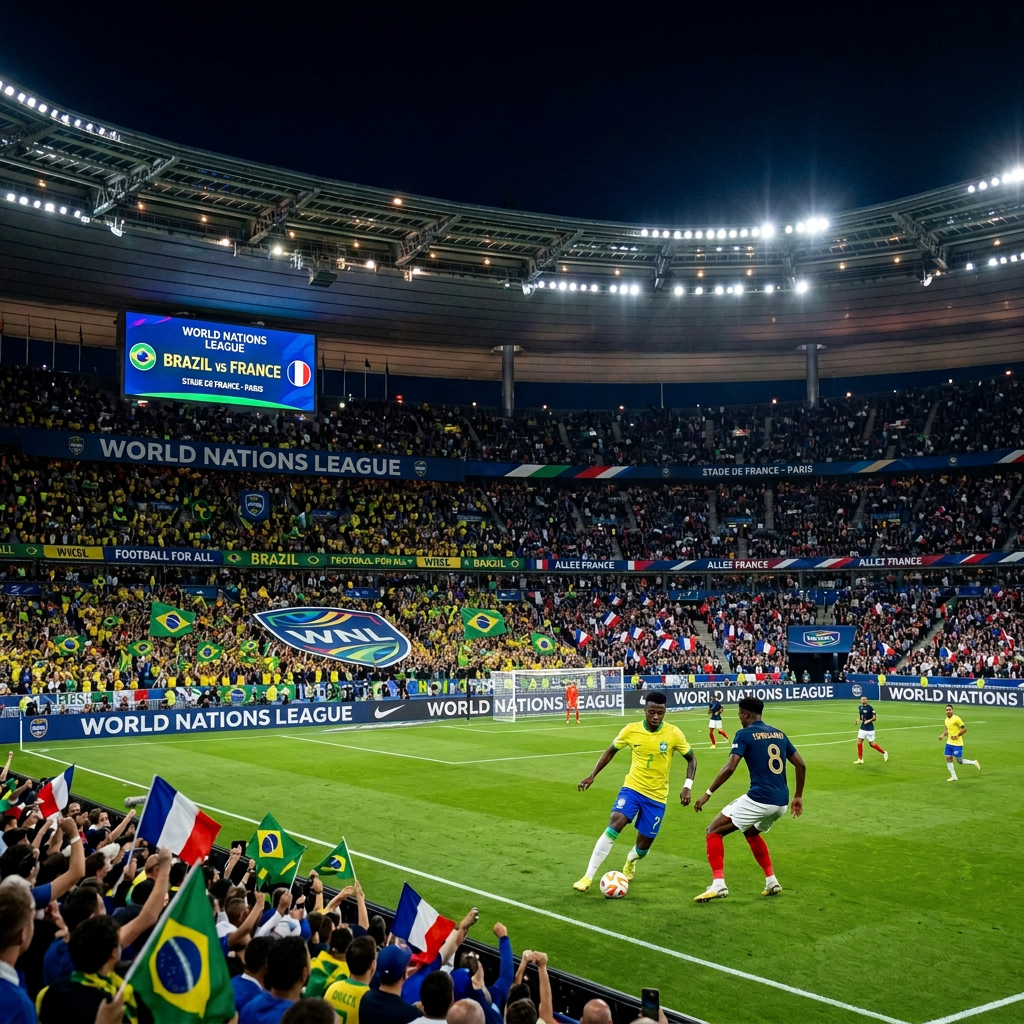
Yes, we get the Euros. We get Copa América, AFCON, the Gold Cup, and the Asian Cup. These tournaments are great — some better than others — but they’re regional. They don’t scratch the same itch. They don’t give us a Brazil vs. France, Japan vs. Argentina, or U.S.A vs. Egypt. They don’t give us the global drama that only happens when the entire world is invited.
And that’s why I think it’s time for a World Nations League.
Why the World Cup Isn’t Enough
The World Cup is special precisely because it’s rare. But rare doesn’t have to mean scarce. We don’t need to dilute it. We need to complement it. Us fans want more meaningful international games, more cross‑continental matchups, more stakes, more storylines, more chances for nations to test themselves outside their region.
We don’t want is more friendlies or meaningless games. Friendlies feel like preseason. They don’t count towards anything and are often not taken seriously by anyone including the players on the field. We want games that matter.
A Tournament Every Odd‑Numbered Year
Here’s the core idea. A World Nations League played every odd‑numbered year — two tournaments per World Cup cycle. Here’s what the 4-year World Cup Cycle looks like:
| Year 1 | World Nations League |
| Year 2 | Continental tournaments (Euros, Copa America, etc.) |
| Year 3 | World Nations League |
| Year 4 | World Cup |
For this to work, qualifying tournaments for the regional tournaments and the World Cup itself would have to be shorter. That would be a welcome change because there would be more meaningful action every year. Plus, each game of qualifying tournaments would have higher stakes.
Every year has meaning. Every year has stakes. Every year has interesting matchups. International soccer becomes alive instead of dormant.
The World Nations Legue itself would be both inclusive and exclusive at the same time. No qualifying. All countries can participate. Just in different divisions so they play teams of comparable strength. They can move up and down through promotion and relegation with a few exceptions. It would look something like this using the FIFA World Ranking as of the date of this post to place teams in hypothetical groups:
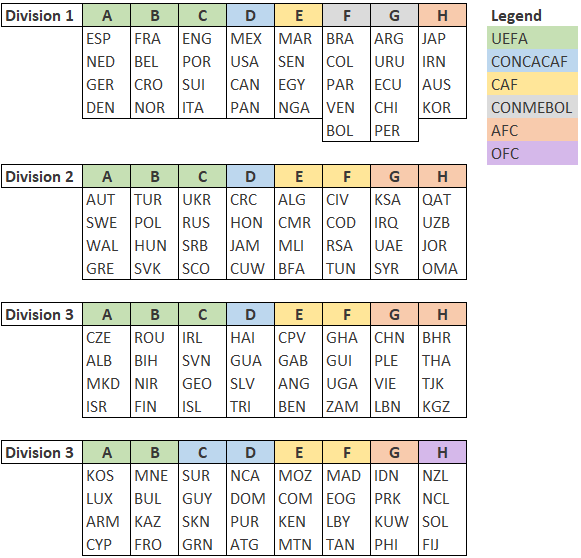
CONMEBOL is a bit of an odd ball. Since it only has 10 teams, and many of them are very competitive, it would be represented by two groups of five in division 1 with no promotion and relegation. A possible solution to this peculiarity would be to have CONMEBOL and CONCACAF compete as a single region. That would allow the promotion and relegation rule to be implemented with no exceptions.
All other divisions contain 8 groups of 4 teams. The groups are regionalized by Confederation to keep travel reasonable. At the end of the group stage the top team in each group qualifies to a summer knockout tournament. First place teams are either promoted to the division above or faces off another team in a play-off for promotion if applicable. The last place team is relegated to the division below or faces off another team for relegation if applicable. This is because the allocation of groups to the Confederation in the different divisions is merit based so there won’t always be the same number of groups for a Confederation per division. Got it? Good.
Why This Works
More meaningful games and less meaningless friendlies. No more “experimental lineups” with nothing on the line. Every match affects promotion, relegation, or knockout qualification. Better development for mid‑tier nations like Japan, Morocco, Mexico, Colombia, Nigeria, South Korea, and Australia who would get regular high‑level competition — not once every four years.
More global parity. The gap between regions shrinks when they actually play each other. More revenue for everyone. Let’s be honest. It’s all about the money. A global Nations League would be a financial engine for federations, broadcasters, and players.
This isn’t about replacing the World Cup. It stays exactly as it is — the crown jewel, the pinnacle, the once‑every‑four‑year spectacle. The World Nations League simply fills the empty space between tournaments with something entertaining for us to get our fix.
Fans Want More — And This Is the Answer.